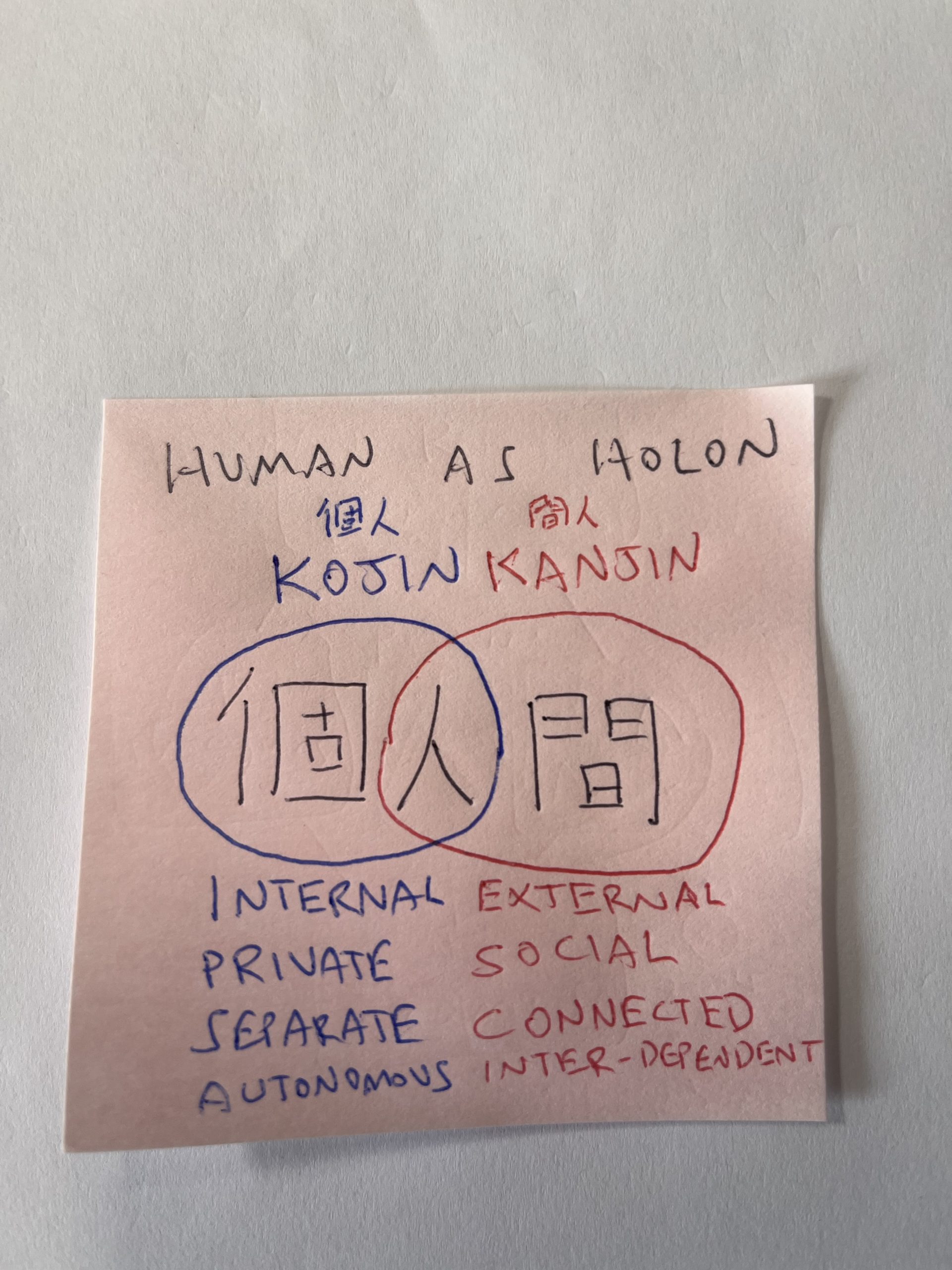
“Group life is actually about the dance between the we and the I. And so, if you have too much we, it’s a cult, and if you have too much I, it’s a federation.” – Priya Parker, expert in conflict resolution and the art of “gathering”
Parker continues:
“And so, part of group life is the tools we have to make sure we have enough voice as an individual, and then also the tools we have to choose to give up some amount of freedom to be part of something greater than ourselves.”
Parkers believes that we try to solve problems with individual therapy that might be better addressed with group therapy:
“I love therapy, I’m in therapy, therapy has helped many people in my family change their lives. And we are using therapy to draw boundaries over bridges. We are using therapy, the excuse of therapy, to focus on separation rather than connection…By the way, most therapists would say, this is not actually how we mean to use boundaries, right? So part of what is happening when we are overusing boundaries is we are isolating ourselves more and more and more.”
Drawing on the work of Martin Buber, she suggests that we need to revisit whether we are treating others as objects (it) or fellow subjects (thou):
“My mentor, Hal Saunders, the first book he ever made me read was Martin Buber’s writings and the relationship between I and thou.”
Buber argued that dialog was transformed relationships from I/it framing to I/thou framing:
“And the idea in my field of dialogue, which is relationships get out of whack when relationships become an I/it, an object of my charity or a task for my redemption. And dialogue, which is the real consideration of other people, moves the relationship from an I/it to an I/thou. It restores the relationship. It restores us to each other.”
From The Ezra Klein Show: Is Your Social Life Missing Something? This Is For You., Feb 3, 2026
Parker shares illustrations ranging from the mundane to the inspirational of what group therapy looks like in the real world: from parties that make it easy for people to talk to strangers, to political campaigns that feel like parties, to dialog groups that create bridges across boundaries.
—
As our communication evolves from I/it to I/thou, I wonder if our relationships evolve as well, passing through developmental phases – sort of like developmental or vertical theory for groups.
Something along the lines of:
– dependence (me – I need you.)
– independence (I – I don’t need you.)
– instrumentality (I/it – I utilize you.)
– mutual instrumentality (I/it + I/it – I utilize you. You utilize me.)
– inter-dependence (we – Neither of us can do without the other.)
– inter-dependability (I/we/I – We each choose to be there for each other and the group.)
—
Agency (主体性) + Purpose (志) + Growth (成長) + Connection (繋がり) + Contribution (貢献) = Meaning (意義)
In the space between you and me awaits all that will ever be.
人と人の間に全てのもと
© Dana Cogan, 2026, all rights reserved.