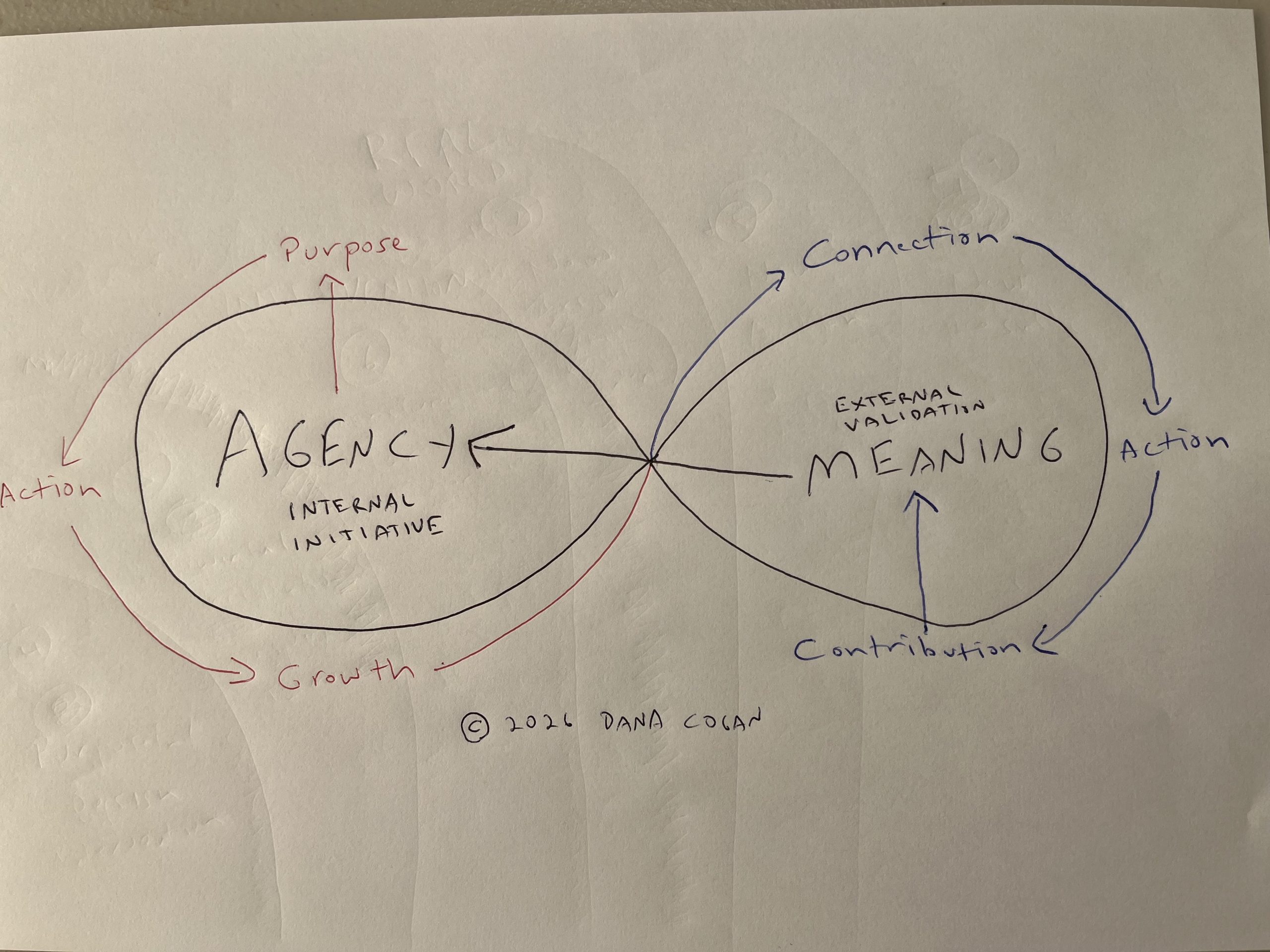
The path from agency to meaning can be thought of as a pair of intersecting feedback loops validating that we matter by connecting the purposes we formulate internally with the contributions we make externally.
Social theorist Hamaguchi Eshun used systems theory to illustrate how this loop might work. In Hamaguchi’s model, the self is a holon. It exists simultaneously both as a discrete entity and as a part of a greater system. He used the Japanese terms 個人 (kojin / individuus) and 間人 (kanjin / relatus) as labels for the internal and external aspects of the self:
“Somewhat like Janus, the god in Roman myth with two faces, one looking upward and the other looking downward, a holon can show an image of a complete whole against the subordinate units in the structure of a system, while also showing a dependent ‘part’ submitting to the upper system that includes the system. Any given system within the stratified structure tries to maintain a dynamic balance between its whole-ness (self-assertive tendency) and part-ness (integrative tendency).”
The outer face of the holon functions as kanjin (contextually-constructed person), while the inner face functions as kojin (internally-constructed person). While seemingly contradictory, the kanjin and kojin coexist as two sides of one entity to constitute a holon self: a self that is at once social and private; a self that even in its individuality sees itself as integrated into society rather than positioned against it. By constructing the person and society as systems interacting on a hierarchy, Hamaguchi presents a workable alternative to the
Western formulation of the individual as independent from and resisting society.
The intersecting feedback loops facilitate the continuous construction and reconstruction of the inner and outer aspects of the self:
“Within this feedback loop of information, the holon exists as a determinant of its large order, while cooperating with it. It also assumes that others exist within itself, while maintaining its own order by the order it formed at the beginning. Strictly speaking, therefore, there is no longer self-other distinctions here, as the ‘holon’ is now an ‘individual’ and a ’whole’ simultaneously.”
The construction of meaning is a process of 具現化 linking the interior and exterior aspects of the self.
—
Agency (主体性) + Purpose (志) + Growth (成長) + Connection (繋がり) + Contribution (貢献) = Meaning (意義)
In the space between you and me awaits all that will ever be.
人と人の間に全てのもと
© Dana Cogan, 2026, all rights reserved.