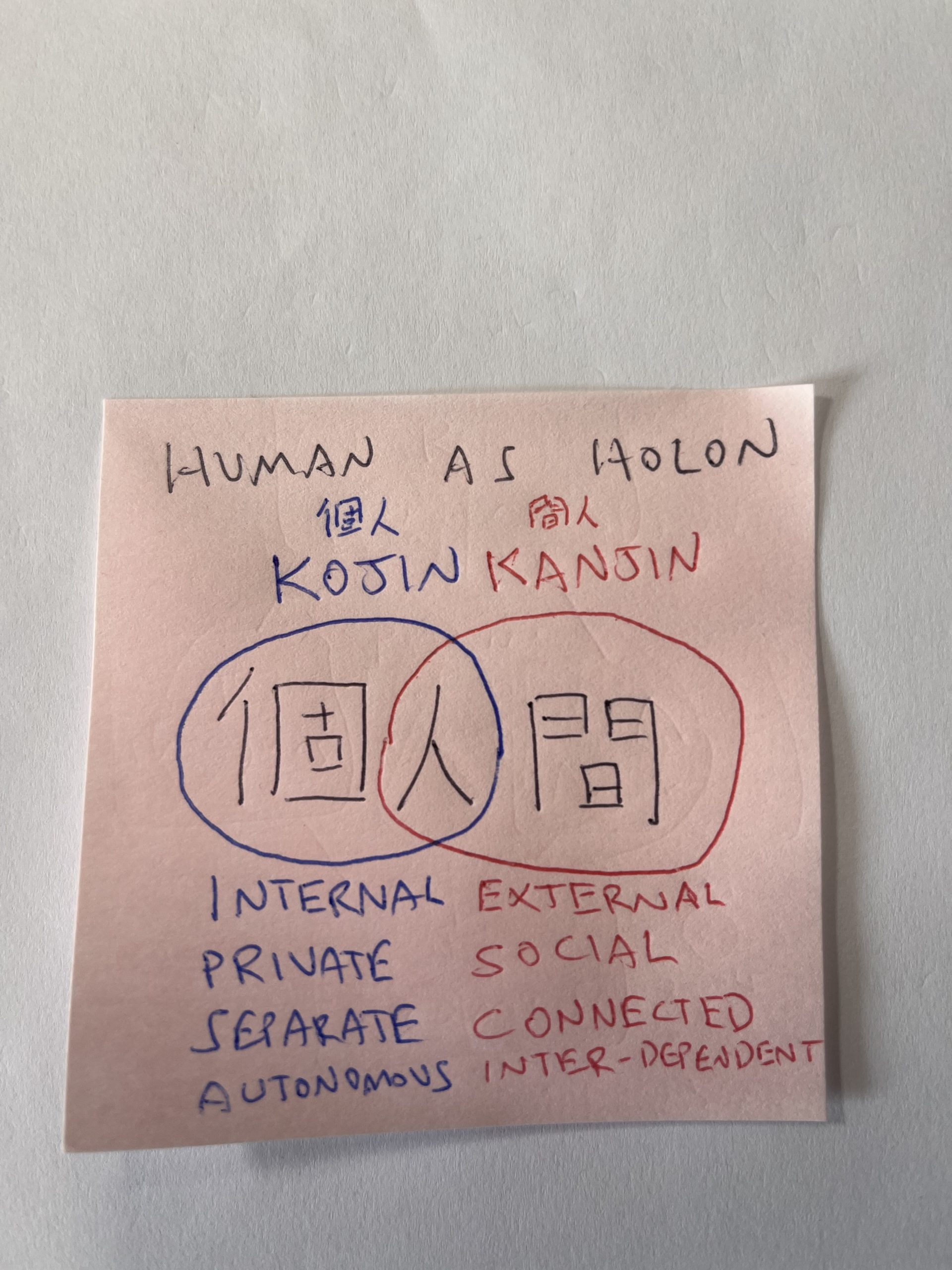
Japanese cultural forms such as literature, manga and anime explore many social aspects of individual existence in a way that resonates for people around the world. What does it mean to be a socially-integrated individual?
Technology has enabled the emergence of a world that seems in many ways to be much more inter-connected than anything experienced or imagined by the great philosophers of past eras.
As Western societies passed through the enlightenment and industrial revolution, we seem to have drifted into a conception of the individual as something that is in an everlasting conflict with other independent individuals. Within this framework, the only way we can co-exist is by negotiating our interests and forming contracts. But does this really reflect how we relate to each other or how we become “selves”?
Hamaguchi Eshun’s kojin/kanjin holon model allows for a more nuanced range of options for explaining the relationships that create and bind individuals. Perhaps harmony and coherence are just as natural as conflict and negotiation. Hamaguchi’s holonic kojin/kanjin conception of the self allows for an alternative way of explaining the existence of individual selves – one that assumes that we have evolved in connection with rather than separately from each other and that our relationships with each other are not necessarily or exclusively characterized by the negotiation of conflicting interests.
Thinkers like Watsuji and Hamaguchi seem to have been primarily interested in articulating new ways to explain the social aspect of the Japanese self, but in the process they have provided us with ways to explore the social aspect of humanity in general. It is not difficult to imagine oneself being simultaneously an inward-looking self and an outward-looking self. Still, before encountering Hamaguchi’s holonic kojin/kanjin self, I had not encountered linguistic or conceptual constructs allowing me to describe myself as being simultaneously independent and inter-dependent.
As an individual trying to make sense of how to make the most of this individual life, I find their ideas comforting and inspiring. Taking a step back from the entanglements of my kanjin existence I am able to notice that I am also an emergent kojin engaged in an unending internal journey of self-development. Taking a step back from the isolation of my kojin existence I am able to notice that even when it feels that I am alone and isolated, I am actually moving together with multitudes of other people as we constantly create and re-create the conditions that shape each other’s journeys. I suspect that the world might be a better place if we all learned to embrace the holonic kojin/kanjin nature of our lives as individuals moving alone and together through time and space.
Hamaguchi Eshun’s kanjin: The Janus self (working draft)
—
Agency (主体性) + Purpose (志) + Growth (成長) + Connection (繋がり) + Contribution (貢献) = Meaning (意義)
© Dana Cogan, 2025, all rights reserved.